
"You still need to practice" – my path from roofer to tattoo artist
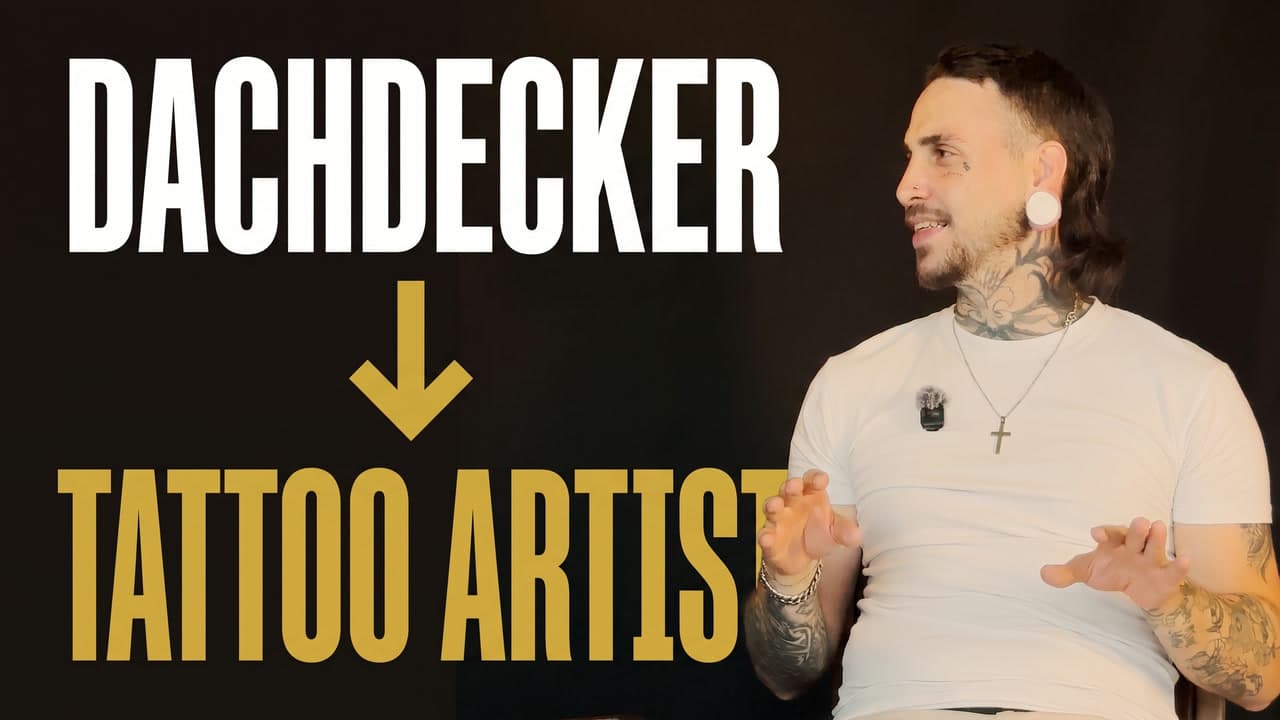
I'm Markus. My people call me Skeet — I've been tattooing for almost eight years, I'm from Witten and I didn't start out with a tattoo machine. I started on a roof.
Roofing, sales — and no interest in being taken for a ride
I originally trained as a roofer. After my apprenticeship I kept at it for another year, switching from company to company — and still found myself out of work every winter: no security, and you get used for the summer business. I didn't do an apprenticeship just to get screwed over afterwards, to put it bluntly. So, through a few detours, I ended up in sales as a career changer — almost four years. And to this day I'm grateful for them, because that's where I learned how to sell. What nobody told me back then: that's exactly what you need every single day as a tattoo artist.
The couch, the postcode and 100 euros from my brother
I've always drawn, ever since I was a kid. After school I took my drawings to the studio, and the answer was the same every time: "You still need to practice." So I practiced — at home, on the couch, on myself. That's where I tattooed the postcode of my birthplace on myself. Until a friend said: before you do that at home, do it at my studio. A clean environment, someone who can step in if the worst happens.
At first I didn't take it seriously at all. I'm very critical of myself and thought: they have no idea. Then my brother gave me my first 100 euros and said: buy your supplies, see it through. So there I was, in the studio on Fridays after work, and on Saturdays too. Every tattoo: 50 euros, no matter what it was. And every euro went straight back into tattooing.
The moment it got serious
My first big order was 1,500 euros — supplies, a machine. How did that feel? Bad. In sales I made around 2,000 euros in a normal month. Do the math: rent gone, the rest of the month blown on tattooing. With no guarantee it would ever come back.
But it became clear pretty quickly: the switch from sales to tattooing — this thing had to be done. And at some point the day came — I stopped showing up to work and got myself let go. The step was done.
Today: more money, more free time — and honestly, more baggage too
Today I run our own studio in Wetter with my colleague Tobi. Our system is simple: the shop costs amount X, we split everything in two, and everyone buys their own supplies. I think that's about the fairest setup you can have as a tattoo artist.
There are weeks when I'm not in the studio at all. And weeks when I'm there all week. I need to bring in enough to cover the shop, the rent and my family — everything beyond that is the cream and the cherry on top of the ice cream. And some months there's no cherry. Doesn't matter, the ice cream still tastes good. I'd rather use that time for my daughter — she's four.
I make more money today than in a normal job, with a lot more free time. But I'll also be honest: there are days when I ask myself whether I'd do it all again knowing what I know now — and sometimes the answer is: no way. Dealing with clients, the tax office, knowing your numbers — there's so much attached to this that has nothing to do with the art anymore. From the outside people say: "You sit down for an hour and collect your 400 euros." Right — and before that I sat three hours over the design, an hour in the consultation, and an hour cleaning afterwards. If you tattoo part-time, you have a full-time job.
What I'd tell anyone starting out
- Get to know the work: I'd recommend anyone start exactly like I did — in a studio, small, without looking at the money. If you only tattoo for the money, you'll notice very quickly that it doesn't work.
- Hold your price: For years I was a fan of discounts. All that does is train clients who only come for the promotions — and getting rid of that again is nearly impossible. Whoever comes to me pays the price I ask. Otherwise they go somewhere else.
- Don't be a lone fighter: After four or five years I realized: you don't get far on your own. Contacts get you better prices, and contacts bring new contacts. Business can be that easygoing and friendly.
- Talk about the dark side too: Your back, your wrist, the pressure — nobody talks about it. If we show what tattooing really carries with it, respect grows for what we do.
If you want to hear the whole conversation — on the Toddcast I tell the story in full, with everything that didn't fit in here.
I'm curious who among you has taken a similar path. Feel free to write to me — you'll find me on Instagram at @skeet_vossi_ink and @skeet_vossi.