
"Honestly, I'm not really happy …" – When a studio smile gets expensive
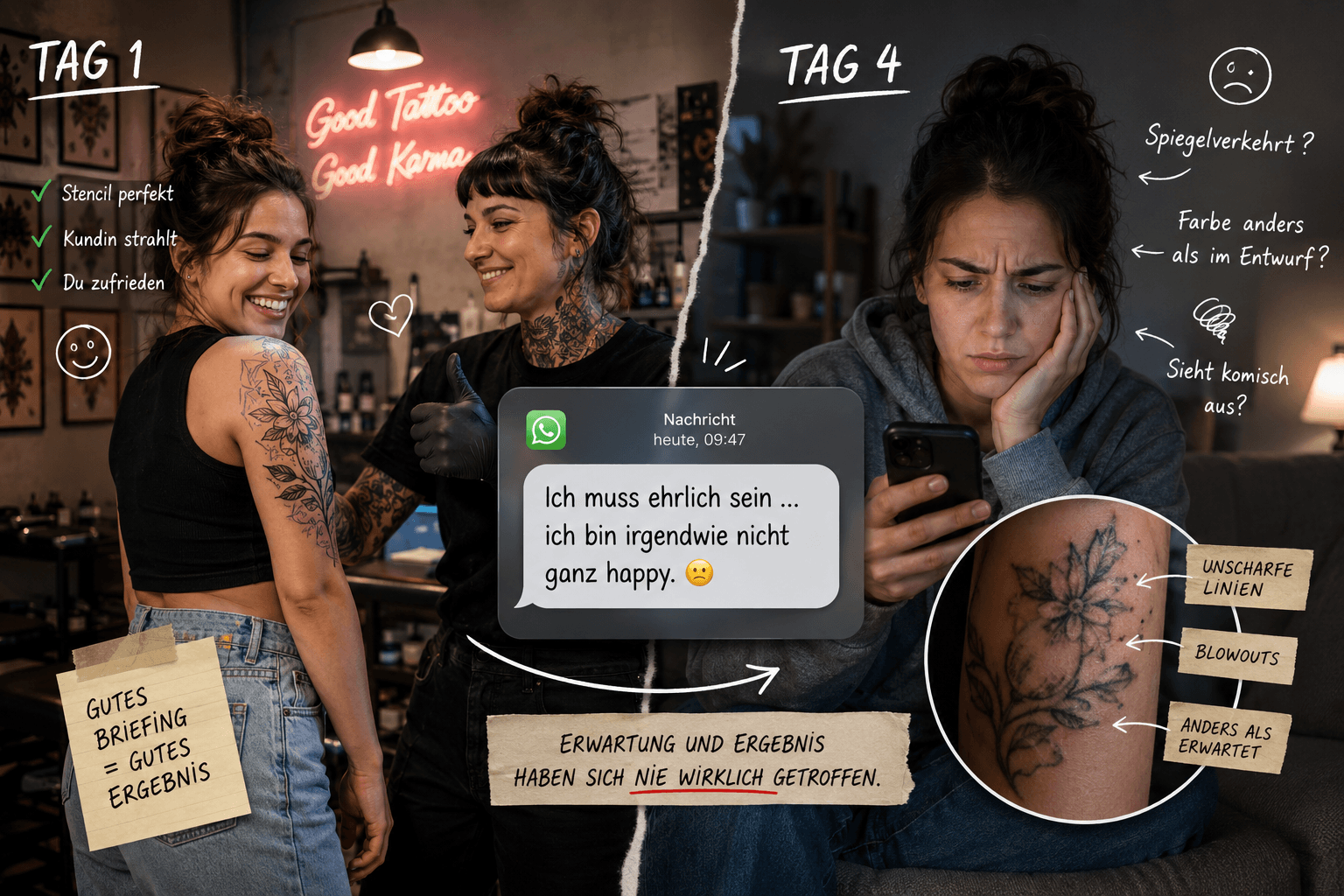
The session went great. The client called the stencil "perfect," beamed on her way out, and you were happy with your work. Three days later, the message pops up: "I have to be honest … I'm not totally happy with it."
Welcome to the club.
This is the topic in the industry right now. In the communities, emotions are running high on both sides: clients desperately post pictures of mirror-flipped motifs or colors that "looked different in the design." On the other side, there's us artists — reporting clients who nod along to everything during the appointment and then threaten to lawyer up afterwards, or demand years of free touch-ups on perfectly intact tattoos.
The problem is almost always the same: expectation and result never actually met.
The serious part: why "well-intentioned" isn't enough in the eyes of the law
Even though we see ourselves as artists, in Germany a tattoo job is legally a work contract (Werkvertrag, § 631 of the German Civil Code). In plain terms: you don't just owe hours of focused effort — you owe a defect-free result. When it goes wrong, it gets expensive.
A German appeals court, the Higher Regional Court of Hamm (ruling of 05.03.2014, case no. 12 U 151/13), made this crystal clear in a case about a botched flower (crooked lines, blowouts):
- No second chance: If the work is defective, the customer does not have to entrust you with their skin again for a correction.
- It gets expensive: In this case it was €750 in pain-and-suffering damages, plus the cost of laser removal.
- Bodily harm: Legally, the customer's consent only covers defect-free work. A botched tattoo therefore counts as bodily harm.
Taste is not a defect — "I don't like it anymore" is not legal grounds for a claim — but crooked lines or a wrongly executed motif absolutely are. The dispute usually lives in the gray zone in between.
The three sticking points (it's rarely about the needle)
Dissatisfaction almost ALWAYS starts at the handover points, before the needle even touches skin:
- Too vague: "Just do something nice, I trust you" is a trap. Plan it only verbally and, if it ever escalates, it's your word against theirs.
- Unannounced changes: You tweak details in the design so the tattoo still looks good in ten years. Craft-wise that's right — but if you don't explain it, back home it looks like a mistake to the client.
- The politeness trap: A polite "yes" in the studio often happens under adrenaline and excitement. A lot of people simply don't dare to contradict the pro.
Your roadmap to stress-free work
To avoid this stress, a clear process that protects you and your art helps:
- Get it in writing: Document the body area, style, color preferences and references before you even talk. An intake tool (like the widget we built) helps you have every must-have detail — photos included — in black and white if things ever get serious.
- Call out deviations proactively: Explain, on your own initiative, why you're making lines bolder or simplifying details. When you justify it, it builds trust.
- The stencil ritual: Leave the client alone with the mirror for a moment. Ask the "brave question": "What would you change if you dared to?" And with lettering, always check the reading direction together.
- Dare to skip it: If someone's unsure, reschedule. A new appointment is always cheaper than a cover-up or weeks of drama — we hear enough drama while we tattoo as it is.
- Clear touch-up rules: Spell them out in your terms (e.g. free touch-ups within 8 weeks). Once it's in writing, there's nothing left to argue about.
Yeah, I know — PAPERWORK — but it's done in one afternoon and it can genuinely save your ass.
Bottom line
The artists with the fewest problems aren't the ones with the best lawyers — they're the ones where, before the first needle hit, everyone involved had the exact same picture in their head.
Processes like these give you back the time you need for what really matters: your art.
Not legal advice — and the law differs from country to country. The German ruling above illustrates a principle that holds in most places: you owe a result, not just good intentions. For your own jurisdiction, check with a local lawyer.